
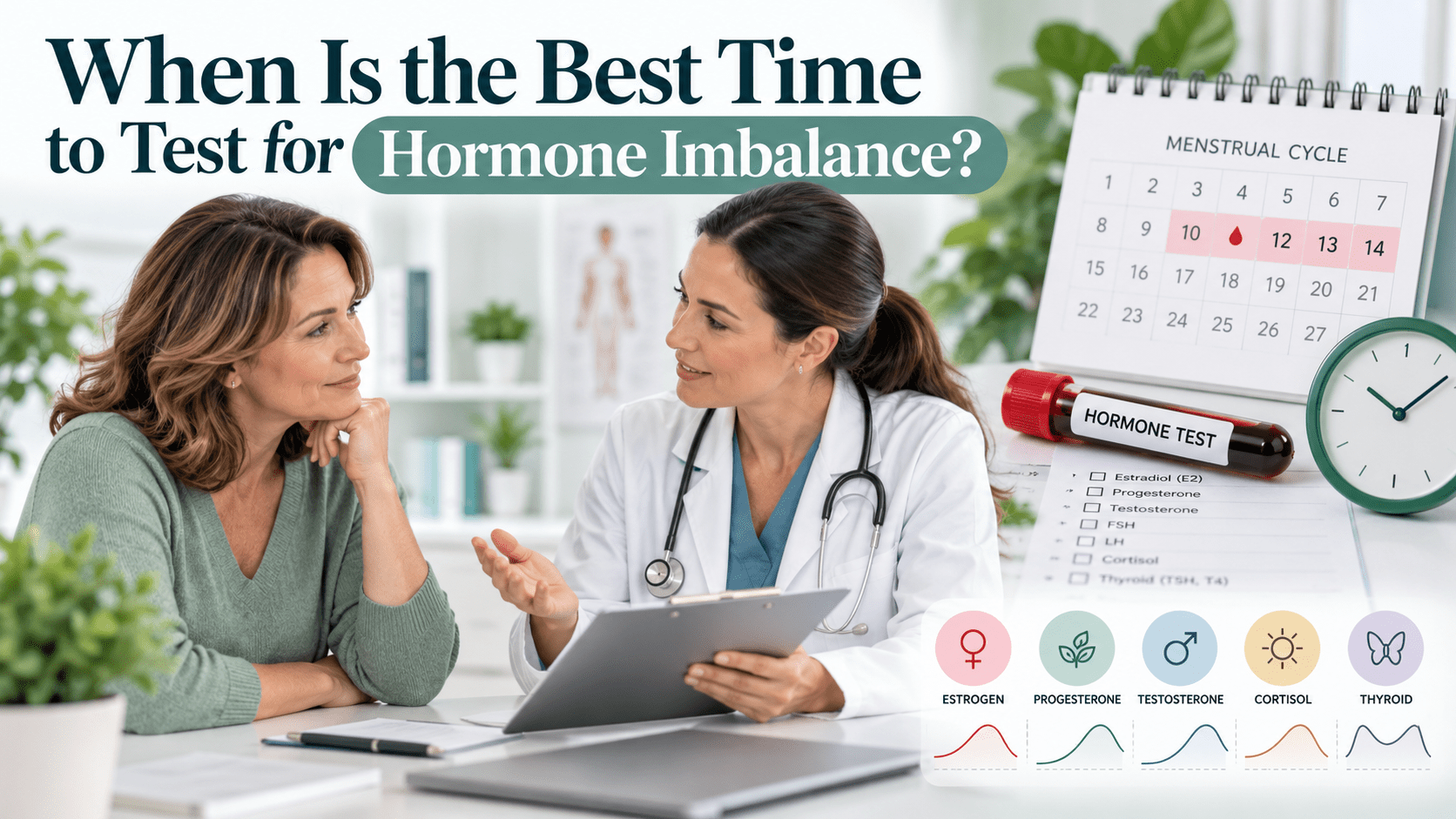
When Is the Best Time to Test for Hormone Imbalance?
The best time to test for hormone imbalance depends on the hormone. Testosterone and cortisol are usually checked in the morning, often before 10 a.m.
For women with regular periods, FSH, LH, and estradiol are typically drawn on days 2 to 4 of the cycle, and progesterone about a week before the next period. During perimenopause or hormone therapy, timing shifts again, so the right plan starts with your symptoms and your provider.
You finally book a blood test for your fatigue, mood swings, or low drive. The results come back “normal,” but you still feel off. Often, the problem isn’t the lab. It’s the timing. Knowing when is the best time to test for hormone imbalance can be the difference between a clear answer and a result that tells you very little.
Hormones rise and fall by the hour, by the day of your cycle, and by your stage of life. This guide walks through each one, so your next test captures what’s really going on.
When Is the Best Time to Test for Hormone Imbalance?
The best time to test for hormone imbalance is when you have symptoms and when the specific hormone being measured is at a predictable point.
For most people, that means an early morning blood draw. For women who still have periods, it also means matching the test to a certain cycle day.
There isn’t one perfect moment for every hormone.
Testosterone, cortisol, and thyroid labs depend mostly on the time of day. Estrogen, FSH, LH, and progesterone depend mostly on where you are in your monthly cycle.
And if you’re already on hormone therapy, the timing of your last dose matters most.
Why Timing Changes Your Hormone Test Results
A single blood test is a snapshot. If that snapshot is taken at the wrong moment, a normal level can look low, or a low level can look normal.
Daily Rhythms
Many hormones follow a 24-hour clock. Cortisol and testosterone run highest in the morning and drop as the day goes on. An afternoon draw can make healthy levels look low.
Monthly Cycles
Estrogen, progesterone, FSH, and LH shift through a woman’s cycle. Each one has a window when the reading means the most. Outside that window, the number is hard to read.
Life Stages That Shift Your Baseline
Perimenopause, pregnancy, breastfeeding, and aging all change your normal levels. So do medications like birth control and hormone therapy. Your provider needs to know where you are before choosing when to test.
What Time of Day Should You Get Hormone Blood Work?
Most hormone blood work is best done in the morning. Testosterone and cortisol peak early in the day, so a draw before 10 a.m. gives the most reliable reading. Thyroid labs are less time-sensitive, but testing at the same time each visit makes results easier to compare.
Testosterone
Clinical guidance for men calls for a draw before 10 a.m. or within three hours of waking, ideally after fasting. A low result isn’t enough on its own. Endocrine Society guidelines recommend confirming low testosterone with a second morning fasting test before making a diagnosis.
Fasting matters more than many people think. In one study, a sugary drink lowered testosterone levels by about 25%, and 15% of men with normal levels dropped into the low range afterward.
In our experience, the most common reason a testosterone test needs repeating is an afternoon draw or a big breakfast beforehand. A quick morning appointment on an empty stomach saves time and a second needle stick.
Cortisol
Cortisol, your main stress hormone, is usually tested early in the morning because it changes so much during the day. Sometimes a provider orders a second draw in the late afternoon to see how much it falls.
Thyroid (TSH, T4, and T3)
Thyroid problems are common and often missed. An estimated 20 million Americans have thyroid disease, and up to 60% don’t know it. A morning draw at a steady time helps track your thyroid function from test to test.
If you take thyroid medication, ask your provider whether to take that day’s dose before or after your blood draw.
What Day of Your Cycle Should You Test Hormones?
For women with regular periods, FSH, LH, and estradiol are usually tested on days 2 to 4 of the cycle, counting the first day of full bleeding as day 1. Progesterone is usually tested about seven days before your next period, which is around day 21 of a 28-day cycle.
Days 2 to 4 for FSH, LH, and Estradiol
Early in the cycle, these hormones sit at a low, steady baseline. That makes it easier to see if something is off. FSH levels change throughout the month, so testing on a set day keeps results meaningful.
About 7 Days Before Your Period for Progesterone
Progesterone rises after ovulation and keeps climbing for about 6 to 10 days before falling if you don’t get pregnant. Testing in that window shows whether you ovulated and whether levels are strong enough. If your cycle is 32 days, your test day shifts later, to around day 25.
What If Your Cycles Are Irregular or You Have PCOS?
Irregular cycles make day-based timing tricky. Your provider may test on a random day, repeat tests a week apart, or wait until a period starts. Tracking your cycle for two or three months before testing gives your provider much better information to work with.
Is There a Best Time to Test Hormones During Perimenopause?
During perimenopause, there’s no single best time to test, because estrogen and FSH swing up and down from week to week. For women over 45 with classic symptoms and changing periods, providers usually diagnose perimenopause from symptoms instead of a single blood test.
UK guidelines advise against using FSH tests to diagnose perimenopause or menopause in most women over 45. Cleveland Clinic doctors describe a perimenopause blood test as only a snapshot in time.
Testing still has a place. It can help if you’re under 45, if you’ve had a hysterectomy, if you use a hormonal IUD, or if your provider wants to rule out thyroid problems. It’s also useful for setting a baseline before starting HRT for women.
When Should You Retest After Starting Hormone Therapy?
Most people retest about 2 to 3 months after starting hormone therapy, then less often once levels are stable. The exact timing depends on your treatment type. Injections, pellets, patches, and creams each have a different window when a blood test gives the most useful reading.
Testosterone Injections
For men on testosterone replacement therapy by injection, guidelines recommend measuring levels midway between injections, with a common target of 400 to 700 ng/dL. Testing the day after a shot shows your peak, not your typical level. If you’re thinking about starting a family, ask how TRT can affect fertility before your first dose.
Hormone Pellets
With hormone pellet therapy, levels rise after insertion and slowly taper. Your provider may check labs a few weeks after insertion and again when symptoms return. Knowing when pellets start wearing off helps you time your next lab draw and appointment.
HRT for Women
Patches, creams, and pills reach steady levels at different speeds. It takes a few weeks for an estradiol patch to start working, so testing too early can be misleading. Your provider will often focus on how you feel, then use labs to fine-tune.
Hormone Test Timing Cheat Sheet
Use this table as a starting point. Your provider may adjust it based on your symptoms and history.
| Hormone | Best Time to Test | Notes |
|---|---|---|
| Testosterone (men) | Before 10 a.m., fasting | Repeat on a second morning to confirm a low result |
| Testosterone on injections | Midway between injections | Avoid testing right after a dose |
| Cortisol | Early morning | A second afternoon draw is sometimes added |
| Thyroid (TSH, T4, T3) | Morning, same time each test | Ask about timing of thyroid medication |
| FSH, LH, estradiol | Cycle days 2 to 4 | Day 1 is the first day of full bleeding |
| Progesterone | About 7 days before your next period | Around day 21 of a 28-day cycle |
| Perimenopause (over 45) | Often not needed to diagnose | Symptoms and cycle changes guide care |
| Any hormone therapy | 2 to 3 months after starting | Then periodically once stable |
When to Hold Off on Hormone Testing
Sometimes the smartest move is to wait a little. These situations can skew results:
- Acute illness: A cold, flu, or recent hospital stay can lower hormone levels for a while. Guidelines advise testing only when you’re well and your sleep schedule is stable.
- Jet lag or shift changes: A shifted sleep cycle shifts your hormone rhythm, too.
- Biotin supplements: High-dose biotin, common in hair, skin, and nail products, can cause falsely high or low lab results, including thyroid tests. Ask your provider how long to pause it before your draw.
- Hormonal birth control: Combined birth control affects FSH measurements, so some reproductive hormone tests aren’t useful while you’re on it.
- Breastfeeding: Reproductive hormones are naturally different while nursing, so results may not reflect your usual baseline.
Never stop a prescribed medication before a test unless your provider tells you to.
How Do You Know It’s Time to Get Your Hormones Checked?
It’s time to get your hormones checked when symptoms like ongoing fatigue, low libido, weight gain, mood changes, poor sleep, or irregular periods last for several weeks without a clear cause. Testing is most useful when symptoms and lab timing line up.
Other signs include hot flashes, night sweats, thinning hair, loss of muscle, and brain fog. Men may notice weaker morning erections or hair changes linked to low testosterone. These symptoms can have many causes, which is why a full picture matters.
Understanding how hormone levels are checked, from blood panels to saliva tests, can help you feel ready for your visit.
How Nulevel Wellness Medspa Times Your Hormone Testing in Gilbert and Show Low
At Nulevel Wellness Medspa, we plan your lab timing before you ever sit down for a blood draw. We look at your symptoms, cycle, medications, and goals, then schedule testing for the window that will give you the clearest answers.
Our lab work can look at more than 133 biomarkers, so we see hormones alongside thyroid, metabolic, and nutrient markers. We offer in-office blood draws and mobile draw options, and results are often ready the next afternoon. When nutrition may play a role, we can add micronutrient testing.
From there, we’ll walk you through your results and discuss options that fit you:
- Bioidentical hormone therapy for women and men
- HRT for women at our Gilbert hormone clinic and Show Low office
- Testosterone therapy, including TRT in Gilbert and TRT in Show Low
- Enclomiphene treatment for men who want to support their own testosterone production
- Hormone pellets for steady, longer-lasting dosing
Every treatment is prescribed and monitored by a licensed provider, and we schedule follow-up labs at the right point in your treatment. If you can’t make it into one of our Arizona locations, you can start with a telehealth consultation.
Get the Timing Right, Get Clearer Answers
The right test at the wrong time can leave you with more questions than answers. Morning draws, the right cycle day, and smart retesting during therapy all help your results reflect how you actually feel.
If you’re in Gilbert, Show Low, or anywhere in Arizona, Nulevel Wellness Medspa can help you time your hormone testing, understand your results, and build a plan that fits your life. Results vary from person to person, and your plan starts with a conversation.
Frequently Asked Questions
What is the best time of day to test hormones?
For most hormones, the best time of day is early morning. Testosterone and cortisol are highest in the morning, so a draw before 10 a.m. gives the most reliable result. Thyroid tests are less sensitive to timing, but testing at the same time each visit makes results easier to compare.
Do you need to fast before a hormone blood test?
It depends on the test. Fasting is recommended for testosterone because eating, especially sugar, can lower levels for a few hours. It’s also needed if glucose or cholesterol are checked at the same draw. Your provider will tell you whether to fast and for how long.
What day of my cycle should I get my hormones tested?
FSH, LH, and estradiol are usually tested on days 2 to 4 of your cycle, counting the first day of full bleeding as day 1. Progesterone is usually tested about seven days before your next period, which is around day 21 of a 28-day cycle. Irregular cycles may need a different plan.
Can I test my hormones while on birth control?
You can, but some results won’t be very useful. Hormonal birth control changes estrogen, progesterone, FSH, and LH levels, so those tests may not reflect your natural hormones. Thyroid, cortisol, and some other labs can still be helpful. Talk with your provider before stopping any birth control.
How soon after starting TRT or HRT should I retest?
Most people retest about 2 to 3 months after starting hormone therapy. For testosterone injections, the blood draw is usually timed midway between doses. After your levels are stable, your provider will typically recheck them a few times a year or when symptoms change.
Where can I get hormone testing in Gilbert or Show Low, AZ?
Nulevel Wellness Medspa offers hormone testing at two Gilbert locations, on Pecos Road and at San Tan Village, and at our Show Low office. We offer in-office and mobile blood draws, results often by the next afternoon, and telehealth consultations for patients across Arizona.

