Does HRT Make You Look Younger?
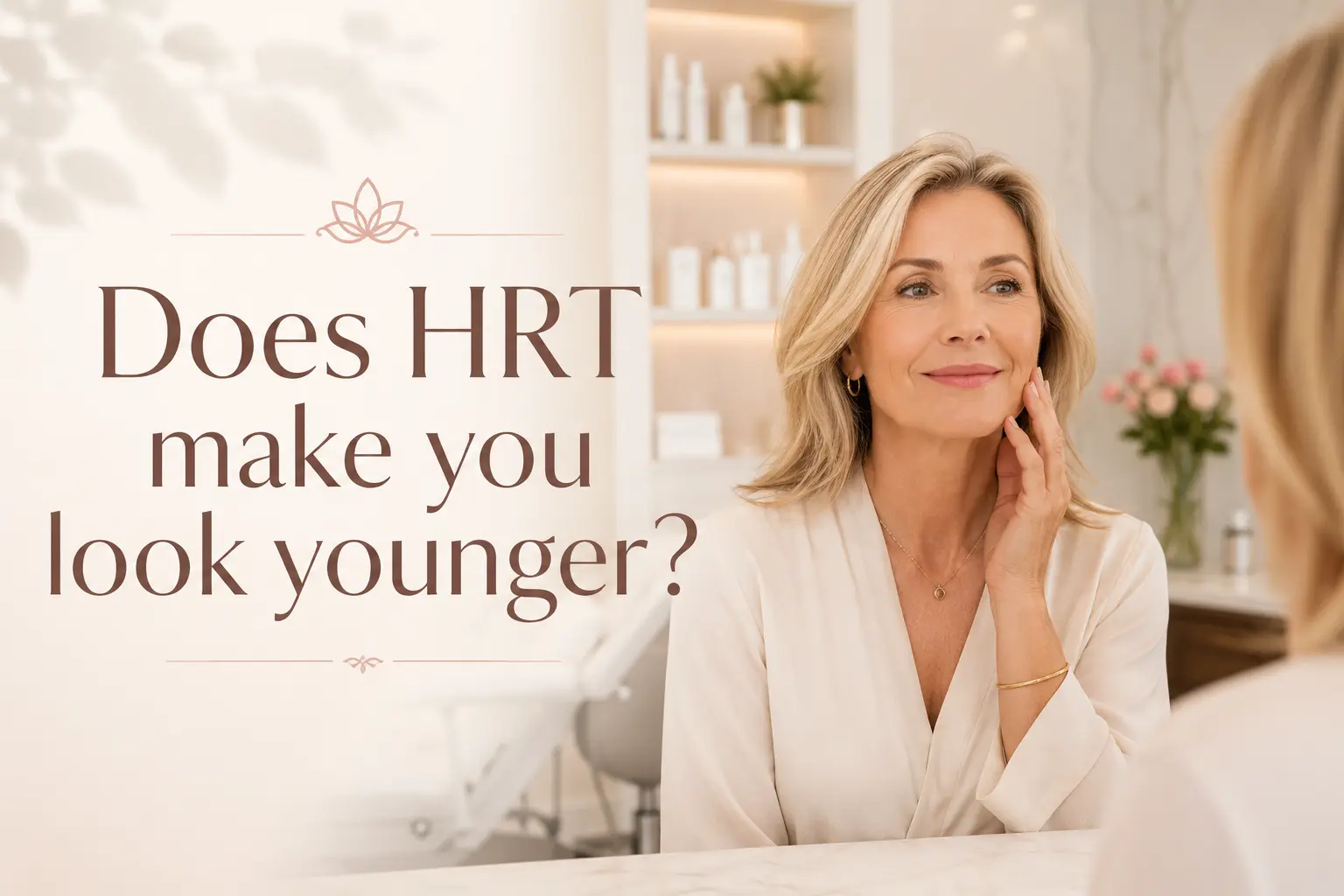
Hormone replacement therapy may help some women look subtly younger or more refreshed by supporting skin collagen, thickness, elasticity, and texture.
However, HRT does not stop aging, dramatically reshape the face, restore significant lost volume, or replace treatments designed specifically for wrinkles, pigmentation, and loose skin.
Results vary from one person to another and generally develop gradually.
Whether you notice a visible difference can depend on your age, menopause stage, skin condition, treatment plan, sun exposure, health, and lifestyle.
HRT may improve certain menopause-related skin changes, particularly reduced collagen, thinning, and loss of elasticity.
These improvements may help your skin look smoother or healthier, but HRT should not be viewed as a facelift or prescribed solely to make you look younger.
This article discusses hormone replacement therapy for perimenopause and menopause.
Why Can Menopause Change the Way You Look?
Menopause is a natural stage of aging associated with declining ovarian function and lower production of hormones such as estrogen.
Perimenopause is the transition leading up to menopause, and symptoms may begin years before menstrual periods stop completely.
Estrogen affects more than reproductive health.
Skin is an estrogen-responsive organ, and estrogen contributes to processes involving collagen, skin thickness, elasticity, moisture retention, and wound healing.
As estrogen levels decline, the skin may gradually become thinner, drier, less firm, or more prone to visible fine lines.
Women may notice changes such as:
- Drier or more sensitive skin
- Reduced firmness and elasticity
- A thinner or more fragile texture
- More visible fine lines
- Slower skin healing
- Changes in facial fullness
- Thinning hair
- Changes in muscle tone or fat distribution
Hormones are only one part of how your appearance changes.
Genetics, ultraviolet exposure, facial movement, smoking, nutrition, stress, sleep, medications, and normal aging also affect the skin.
Menopause symptoms may influence your appearance indirectly as well.
Night sweats, interrupted sleep, hot flashes, and fatigue can leave you looking less rested even when the underlying structure of your skin has not changed.
Does HRT Make You Look Younger?
HRT may help some women achieve a smoother, healthier, or more rested appearance, but the changes are usually subtle.
It is more accurate to say that HRT may improve certain effects of declining estrogen than to say it reverses aging.
Hormone therapy cannot turn back your biological age.
It may support estrogen-responsive tissues, including the skin, when prescribed for an appropriate patient.
The researchers found that menopausal hormone therapy was associated with improvements in skin elasticity, collagen content, skin thickness, and wrinkle severity.
They also noted that additional well-designed clinical trials are needed.
The studies included different hormone formulations, treatment durations, participant groups, and measurement methods.
The findings therefore cannot predict exactly how much improvement one person will see or how quickly it will occur.
Does HRT Increase Collagen?
HRT may help maintain or increase skin collagen in some postmenopausal women.
Collagen is a structural protein that helps give skin its strength and firmness.
Collagen naturally declines with age, and lower estrogen levels during menopause may contribute to a faster loss of the skin’s supportive structure.
Research suggests that systemic estrogen therapy can affect collagen content and skin thickness.
However, an increase in collagen does not necessarily mean you will see a dramatic cosmetic transformation.
Improved collagen may help the skin look smoother or feel firmer, but HRT is not expected to refill hollow cheeks, restore major facial volume, or produce a lifting effect.
Does HRT Improve Skin Elasticity?
HRT may improve skin elasticity in some women.
Elasticity is the skin’s ability to stretch and return to its previous shape.
When elasticity decreases, the skin may feel less firm, and fine lines or creases may become more noticeable.
The available research suggests that menopausal hormone therapy may improve elasticity and skin thickness.
These changes may contribute to healthier-looking skin, but they are unlikely to tighten moderate or advanced skin laxity.
Loose skin can also be affected by sun damage, genetics, facial fat loss, changes in bone structure, and the natural breakdown of collagen and elastin.
Does HRT Help With Wrinkles?
HRT may modestly improve some fine wrinkles associated with skin thinning, collagen loss, and reduced elasticity.
It is less likely to significantly change deep wrinkles caused by years of facial movement or sun exposure.
Forehead lines, crow’s feet, and lines between the eyebrows are influenced heavily by repeated muscle contractions.
HRT does not directly relax those facial muscles.
HRT may improve overall skin quality without producing the targeted wrinkle reduction associated with neuromodulators, resurfacing treatments, or other aesthetic procedures.
HRT Skin Before and After: What Changes Are Realistic?
HRT skin before-and-after results are unlikely to resemble the dramatic transformations commonly shown for cosmetic procedures.
Realistic changes may include:
- A smoother overall skin texture
- Mild improvement in firmness or elasticity
- Less noticeable fine wrinkling
- Increased skin thickness
- A healthier or less fragile appearance
- Possible improvement in dryness
- A more rested appearance when sleep and night sweats improve
Changes that should not be expected include:
- A dramatically different facial shape
- Complete removal of wrinkles
- Restoration of substantial facial volume
- Lifting of loose jowls or neck skin
- Removal of brown spots or sun damage
- Permanent tightening of sagging skin
Before-and-after results can also be difficult to judge because lighting, makeup, facial expression, hydration, camera distance, and skincare may change how the skin appears in photographs.
The most meaningful way to assess progress is to use consistent photographs and discuss your symptoms and treatment response with your provider over time.
Does HRT Change Your Face?
Menopausal HRT does not usually cause a dramatic change in facial shape or structure.
Some women may notice subtle differences in skin texture, thickness, elasticity, or moisture.
Others may look more rested if treatment helps reduce night sweats, hot flashes, or sleep disruption.
HRT is not expected to:
- Change your facial bones
- Create a facelift-like effect
- Restore substantial cheek volume
- Permanently define the jawline
- Remove deep facial folds
- Correct visible sun damage
- Eliminate expression lines
Changes in fluid retention may temporarily affect how the face looks, particularly when treatment is started or adjusted.
Any persistent swelling or other unexpected changes should be discussed with the prescribing provider.
Can HRT Affect Your Hair and Body Composition?
Hormonal changes can affect the hair and body, but HRT is not a guaranteed treatment for hair loss, weight gain, or body reshaping.
Does HRT Help With Thinning Hair?
Some women notice changes in hair density or texture during perimenopause and menopause.
However, thinning hair can have many causes, including genetics, thyroid conditions, nutrient deficiencies, stress, medications, and different forms of alopecia.
Correcting a hormone imbalance may help in certain situations, but HRT should not automatically be expected to regrow hair.
A proper evaluation may include a review of your symptoms, medications, family history, nutrition, thyroid health, and relevant laboratory results.
Does HRT Change Your Body Shape?
HRT does not reliably cause weight loss or dramatically reshape the body.
Menopause may coincide with changes in muscle mass, activity level, metabolism, sleep, and fat distribution.
HRT may affect some of these factors indirectly, but nutrition, resistance exercise, sleep, genetics, and age remain significant influences.
Some women experience temporary bloating or fluid retention after starting or adjusting hormone therapy.
Others may feel more able to exercise if sleep, energy, or menopause symptoms improve.
HRT should not be promoted as a weight-loss or body-contouring treatment.
How Long Does HRT Take to Improve Skin?
There is no universal HRT skin timeline.
Certain menopause symptoms may improve before visible changes in the skin occur.
Collagen production and changes in skin thickness are gradual biological processes, so skin-related results are generally assessed over several months rather than days.
A small pilot study involving 24 participants evaluated skin changes over six months.
Women receiving hormone therapy experienced improvements in average skin moisture, elasticity, and thickness by the end of treatment.
Because the study was small, its results should not be used to promise a six-month outcome for every patient.
Your timeline may depend on:
- Your age and stage of menopause
- How long estrogen levels have been low
- Your skin condition before treatment
- The type and dose of hormone therapy
- How the hormones are administered
- Your response to treatment
- Consistency with your prescribed plan
- Sun exposure and skincare
- Sleep, nutrition, exercise, and smoking status
Taking a higher dose does not necessarily create faster or more visible skin results.
Hormone doses should only be adjusted by the prescribing provider based on symptoms, response, side effects, and medical considerations.
Does the Type of HRT Matter for Skin Changes?
Yes.
Systemic hormone therapy and local vaginal hormone therapy are not the same.
Systemic HRT
Systemic HRT delivers hormones throughout the body.
Depending on the treatment, hormones may be administered through pills, patches, gels, sprays, or certain other delivery methods.
The studies evaluating skin collagen, elasticity, thickness, and wrinkles generally concern systemic menopausal hormone therapy.
Systemic therapy is also used for symptoms such as hot flashes and night sweats.
Low-Dose Vaginal Estrogen
Low-dose vaginal estrogen acts mainly on vaginal and vulvar tissues.
It is commonly used for concerns such as vaginal dryness, irritation, urinary symptoms, and discomfort during sexual activity.
Because only a small amount typically reaches the bloodstream, someone using only low-dose vaginal estrogen should not assume it will produce noticeable changes in facial skin, collagen, or wrinkles.
The appropriate type of hormone therapy depends on the symptoms being treated, not solely on appearance goals.
Does Bioidentical HRT Make You Look Younger?
Bioidentical HRT may support skin changes in some women, but the word “bioidentical” does not guarantee stronger cosmetic results.
Bioidentical hormones have the same chemical structure as hormones produced by the human body.
A treatment’s effects still depend on factors such as:
- The hormone being prescribed
- The dosage
- The delivery method
- Whether progesterone is also needed
- Your age and menopause stage
- Your health history
- Your individual response
Bioidentical does not mean that a treatment is free of side effects or appropriate for everyone.
Hormone therapy should be prescribed and monitored based on an individual medical assessment.
What Can HRT Not Change?
Even when HRT benefits the skin, it cannot correct every visible sign of aging.
HRT generally will not:
- Erase deep expression lines
- Restore substantial lost facial volume
- Lift significantly loose skin
- Remove sunspots or pigmentation
- Correct acne scars
- Change facial bone structure
- Permanently tighten the neck or jawline
- Stop the natural aging process
Skin aging has multiple causes.
A concern driven mainly by muscle movement, pigmentation, volume loss, or sun damage may respond more directly to an aesthetic treatment than to HRT.
HRT vs. Cosmetic Treatments for Looking Younger
HRT and cosmetic treatments have different purposes.
HRT is used to address appropriate symptoms and health effects associated with the menopause transition.
Aesthetic procedures are selected to address specific visible concerns.
| Concern | Can HRT help? | A more targeted approach may include |
| Menopause-related skin thinning | Possibly | Microneedling or skin resurfacing |
| Mild loss of elasticity | Possibly | Microneedling or skin-tightening treatments |
| Forehead lines or crow’s feet | Limited effect | Neuromodulator injections |
| Hollow cheeks or volume loss | Not reliably | Dermal fillers |
| Uneven skin texture | Possibly, but indirectly | Microneedling, facials, peels, or resurfacing |
| Sunspots and pigmentation | No direct effect | Chemical peels, IPL, or laser treatments |
| Dry or dull skin | Possibly | Skincare and hydration-focused treatments |
| Hot flashes plus skin changes | May be appropriate | Medical evaluation for HRT |
Nulevel Wellness Medspa provides hormone care and aesthetic services in Gilbert, AZ.
Available skin-focused services include microneedling, neuromodulators, laser facial procedures, skin-tightening options, and medical-grade skincare.
Evaluating hormonal symptoms and cosmetic concerns separately can help prevent unrealistic expectations.
In some cases, a combined plan may be considered when both concerns are present.
Should You Take HRT Just to Look Younger?
HRT should not be started solely to make someone look younger or prevent normal aging.
Hormone therapy is commonly used to manage bothersome menopause symptoms, including hot flashes, night sweats, and sleep disruption.
Systemic therapy may also provide benefits involving bone health in appropriately selected patients.
Possible improvements in skin quality should be viewed as a secondary effect rather than the primary reason for treatment.
Whether HRT is appropriate depends on factors such as:
- Your symptoms
- Your age
- Your menopause stage
- How long it has been since menopause began
- Whether you have a uterus
- Your personal and family medical history
- The type, dose, and delivery route being considered
- Your treatment goals and risk factors
Hormone therapy can carry risks, and the balance of benefits and risks differs among patients.
A provider should review your history before recommending treatment.
How Can You Support Your Skin During Menopause?
HRT cannot compensate for every factor involved in skin aging.
A consistent routine can help protect your skin whether or not you use hormone therapy.
Use Daily Sun Protection
Ultraviolet exposure contributes to collagen breakdown, pigmentation, and wrinkles.
Apply broad-spectrum sunscreen to exposed skin and reapply as directed when spending time outdoors.
Follow a Suitable Skincare Routine
A basic routine may include gentle cleansing, moisturizing, and sun protection.
Additional products may be considered based on your skin type, tolerance, and concerns.
Eat Adequate Protein
Protein supplies amino acids used to build and repair tissues.
A balanced diet that also includes fruits, vegetables, healthy fats, vitamins, and minerals supports overall skin health.
Perform Resistance Exercise
Strength training supports muscle, posture, mobility, and bone health.
It may also help preserve body composition as you age.
Prioritize Sleep
Addressing hot flashes, night sweats, stress, alcohol intake, sleep habits, and other causes of disrupted sleep may help you feel and look more rested.
Avoid Smoking
Smoking contributes to collagen breakdown, premature wrinkles, uneven skin tone, and slower healing.
Personalized HRT in Gilbert, AZ
Changes in your skin, sleep, energy, hair, or body may occur around the same time as perimenopause or menopause, but that does not mean hormone therapy is the only possible cause.
At Nulevel Wellness Medspa in Gilbert, AZ, the evaluation process includes a review of your symptoms, medical history, health concerns, and treatment goals.
When appropriate, a personalized and medically supervised hormone plan may be discussed.
When your main concern is a deep wrinkle, pigmentation, facial volume loss, or loose skin, an aesthetic treatment may offer a more direct approach.
Separating medical goals from cosmetic goals helps create a plan based on what each treatment can realistically do.
Contact us to learn more today.
The Bottom Line
Does HRT make you look younger?
It may help some women look subtly smoother, healthier, or more rested by supporting collagen, skin thickness, elasticity, and relief from disruptive menopause symptoms.
HRT cannot stop aging, dramatically reshape the face, restore substantial volume, remove sun damage, or replace treatments designed for specific cosmetic concerns.
The decision to use hormone therapy should be based on your symptoms, health history, potential benefits, risks, and overall treatment goals, not appearance alone.
A personalized evaluation can help determine whether hormonal changes are contributing to how you feel and what you see in the mirror.
FAQs: Does HRT Make You Look Younger
Does estrogen make your face look younger?
Estrogen may support skin collagen, thickness, elasticity, and moisture retention. These effects may help the skin look smoother or healthier, but estrogen will not dramatically change facial structure, restore major volume loss, or create a facelift-like result.
Does HRT improve skin?
HRT may improve collagen content, skin thickness, elasticity, and some fine wrinkles in certain postmenopausal women. Results vary, and HRT is not intended to treat every cosmetic skin concern.
How long does HRT take to improve skin?
Skin changes generally take time. Studies often evaluate elasticity, thickness, moisture, and collagen over several months. There is no guaranteed timeline, and some women may notice little or no visible change.
Does HRT improve thinning hair?
HRT is not a guaranteed treatment for hair loss. Thyroid conditions, nutrient deficiencies, genetics, medications, stress, and different types of alopecia can also contribute to thinning hair.
Can you take HRT for the rest of your life?
Some women can continue HRT long term, but there is no single treatment duration that is appropriate for everyone. There is also no mandatory age at which all women must stop. The decision should be reviewed regularly based on your symptoms, age, dose, delivery method, medical history, side effects, and whether the benefits continue to outweigh the risks. Some women may continue HRT after age 65 under medical supervision, while others may need to reduce, change, or stop treatment. Never discontinue prescribed hormones without first discussing the safest approach with your provider.
How long does it take to lose weight on HRT?
There is no standard weight-loss timeline because HRT is not a weight-loss treatment and may not cause weight loss on its own. Estrogen therapy may influence where fat is stored, while relief from night sweats, poor sleep, or other menopause symptoms may make healthy eating and regular exercise easier. However, any change in weight will depend on factors such as nutrition, activity, sleep, muscle mass, age, and overall health. A provider can help determine whether hormones or another concern may be affecting your weight.