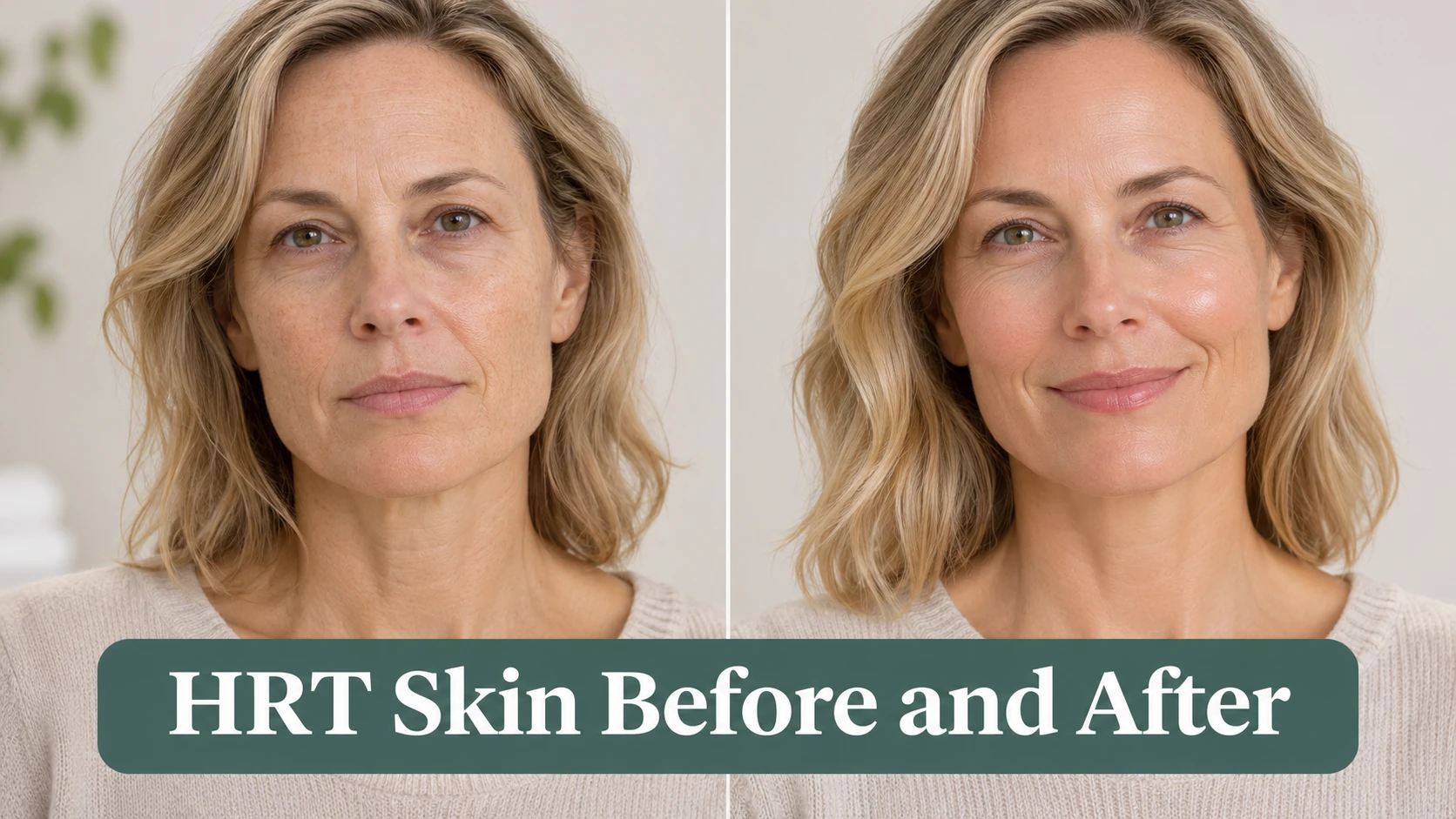
HRT Skin Before and After
HRT may help skin that has thinned and dried out after menopause.
Studies show estrogen therapy can raise collagen, thicken skin, and improve elasticity, which may soften fine lines.
Changes usually come slowly, over several months, and results vary from person to person.
HRT won’t erase deep wrinkles or sun damage, and it isn’t prescribed for skin alone.
It often works best alongside good skin care and in-office treatments.
You look in the mirror and your skin just doesn’t feel like yours anymore.
It’s drier, thinner, and fine lines seem to show up overnight. If you’re searching for HRT skin before and after results, you’re probably wondering one thing: will hormone therapy bring my skin back?
The honest answer is that it may help, and the changes are real but gradual.
Below, we’ll walk through what happens to skin when estrogen drops, what research has measured, a realistic timeline, and how to track your own progress.
We’ll also cover how hormone replacement therapy for women fits with other skin treatments.
What Happens to Your Skin When Estrogen Drops?
When estrogen falls during perimenopause and menopause, skin makes less collagen, holds less water, and gets thinner.
That’s why many women notice dryness, crepey texture, new fine lines, and slower healing in their 40s and 50s, even if their skin care routine hasn’t changed.
Estrogen helps skin cells make collagen, the protein that keeps skin firm.
It also supports oil glands and the natural moisture barrier. When levels drop, all of those systems slow down at once.
Collagen Loss After Menopause
The drop happens fast at first.
Women’s skin loses about 30% of its collagen in the first five years of menopause, then about 2% each year after that.
Older research found that skin collagen and skin thickness decline 1 to 2% per year after menopause.
This happens at the same pace as bone loss, which shows how closely skin and estrogen are linked.
Common Signs of “Low Estrogen Face”
“Low estrogen face” isn’t a medical term, but it describes changes many women recognize.
These include:
- Dry, tight, or itchy skin
- Thinner, crepey skin, especially around the eyes and neck
- More visible fine lines and wrinkles
- Loss of firmness along the jawline and cheeks
- Easier bruising and slower healing
- Dullness or uneven tone
Skin changes often show up with other symptoms, like hot flashes, poor sleep, and thinning hair.
If several of these sound familiar, they may be among the signs you may need HRT.
HRT Skin Before and After: What the Research Shows
The best summary so far is a 2023 review of 15 studies with about 1,589 women.
It found that menopausal hormone therapy increased skin collagen, thickness, and elasticity and reduced wrinkle severity compared with women not on hormones.
Changes Studies Have Measured
Here’s what “before and after” looked like across those studies:
- Collagen: The biggest measured improvement. Women on HRT had more collagen in their skin.
- Skin thickness: Skin became noticeably thicker, which can make it look less crepey.
- Elasticity: Skin bounced back a bit better, though this change was smaller.
- Wrinkles: Wrinkle severity went down modestly.
These are the same reasons many women feel HRT makes you look younger.
The effect comes from healthier skin structure, not from a filter or a quick fix.
Where the Evidence Is Mixed
The same review found no clear improvement in skin dryness, and the results varied a lot from study to study.
Many of the trials were small, and they used different hormones, doses, and ways of measuring skin.
That’s why we’re careful with promises. Some women see a big difference in their skin.
Others notice only small changes, even when their other menopause symptoms improve a lot.
How Long Does HRT Take to Improve Skin?
Most women notice skin changes gradually, over three to twelve months.
Hydration and comfort may improve first, while changes in firmness and fine lines take longer because collagen rebuilds slowly.
There’s no exact schedule, and your timeline depends on your age, dose, and skin habits.
Your hormone levels themselves can shift within weeks.
If you’re curious how fast that part works, it helps to know how long it takes an estradiol patch to start working. Skin simply moves slower than hot flashes or sleep.
A Typical HRT Skin Timeline
This is a general pattern women commonly describe, not a guarantee:
- Months 1 to 3: Skin may feel less tight and dry. Some women say makeup sits better.
- Months 3 to 6: Texture may look smoother, and skin may look less dull.
- Months 6 to 12: Firmness and fine lines may slowly improve as collagen builds back up.
In our experience, patients often notice better sleep and energy before they notice their skin. That’s normal.
We usually ask patients to wait at least six months before judging their skin results.
Can HRT Reverse Wrinkles and Sagging?
HRT can’t fully reverse deep wrinkles or sagging.
It may soften fine lines and improve skin thickness, but it won’t undo years of sun damage or lift loose skin.
For deeper lines and volume loss, in-office treatments usually do more than hormones alone.
Sagging comes from several things at once: collagen loss, fat shifting in the face, and even bone changes.
Hormones mostly help the collagen part.
That’s why women who want a firmer jawline often add skin tightening or a collagen-stimulating injectable like Sculptra.
What Affects Your HRT Skin Results?
No two women get the same before and after.
A few key factors make a difference.
Timing and Age
Starting earlier tends to help more, since you’re protecting collagen before much of it is gone.
Research generally views hormone therapy as most favorable for women under 60 or within about 10 years of menopause.
Women starting later can still benefit, and there’s more to know about HRT after 65.
Type of Hormone Therapy
Estrogen can be given as a pill, patch, gel, cream, or pellet.
Each delivers hormones differently, and your provider will pick based on your health and goals.
You can compare options like an estrogen patch or cream, hormone pellet therapy, and bioidentical hormone therapy.
Sun, Smoking, and Skin Care Habits
Hormones can’t protect skin from the sun.
Daily sunscreen, a gentle cleanser, and a good moisturizer still matter.
The American Academy of Dermatology suggests broad-spectrum SPF 30 or higher and a retinoid to help with menopause skin.
Smoking speeds up collagen loss and can cancel out much of what HRT does.
If you have sun spots or redness, an IPL photofacial targets that damage directly.
How to Track Your Own HRT Skin Before and After
Skin changes slowly, so it’s easy to miss progress.
A simple record makes it much easier to see what’s working.
- Take baseline photos before you start: Use the same spot, the same window light, no makeup, and the same angle (front and both sides).
- Repeat photos every 3 months: Compare them side by side instead of judging from the mirror.
- Keep a short skin diary: Rate dryness, tightness, and texture from 1 to 10 each month.
- Keep your routine steady: Adding several new products at once makes it hard to tell what helped.
- Bring your notes to follow-up visits: They help your provider decide if your dose is right.
Is HRT Safe to Use for Skin Benefits?
HRT is not prescribed for skin alone.
It’s used to treat menopause symptoms, and better skin is a welcome side benefit.
For many healthy women under 60, the benefits often outweigh the risks, but safety depends on your personal health history and should be reviewed with a licensed provider.
Safety guidance has also shifted. In November 2025, the FDA began removing boxed warnings on hormone therapy about heart disease, breast cancer, and dementia.
HRT still has risks, and it isn’t right for everyone, including some women with a history of certain cancers, blood clots, or stroke.
Your provider will also talk with you about how long to stay on HRT, since skin benefits tend to fade once hormones stop.
Pairing HRT With Skin Treatments for Better Results
Combining HRT with in-office skin treatments often gives better results than either one alone.
HRT supports the skin from the inside by helping collagen and thickness, while treatments like microneedling and laser resurfacing target texture, lines, and tone on the surface.
Think of it this way: hormones help your skin respond, and treatments give it a reason to rebuild.
Popular pairings include:
- Microneedling: Creates tiny channels that prompt new collagen. Great for texture and fine lines.
- PRP facial rejuvenation: Uses growth factors from your own blood to support skin repair.
- Laser skin resurfacing: Removes damaged outer layers to improve wrinkles, scars, and tone.
In our experience, women whose estrogen levels are balanced often heal comfortably and see steady results from collagen treatments.
Because menopausal skin is thinner, we tailor treatment strength to your skin rather than using a one-size-fits-all approach.
How Nulevel Wellness Medspa Helps With Menopause Skin Changes
At Nulevel Wellness Medspa, we look at your skin and your hormones together.
Many of our patients come in for hot flashes or fatigue and are surprised when their skin starts to feel healthier too.
Your care starts with a consultation and lab work, since checking your hormone levels lets us build a plan around your body instead of guessing.
From there, we may recommend options such as:
- Hormone therapy: Patches, creams, pellets, or bioidentical hormones, matched to your symptoms and health history.
- Skin treatments: Microneedling, PRP, laser resurfacing, skin tightening, and injectables to target lines, texture, and firmness.
- Home care: Medical-grade skin care to protect your results between visits.
We offer HRT in Gilbert and Show Low, Arizona, plus telehealth visits for patients located in Arizona.
Every treatment starts with a medical evaluation by a licensed provider, and individual results vary.
If menopause has changed your skin and you want a clear, honest plan, Nulevel Wellness Medspa can help you understand your hormones, set realistic goals, and combine HRT with skin treatments that fit your life.
FAQs: HRT Skin Before and After
Does HRT make your skin glow?
Some women say their skin looks brighter and more hydrated on HRT, but there’s no guaranteed “HRT glow.” Any change usually comes gradually over several months, and results vary based on age, dose, sun exposure, and skin care habits.
Can HRT restore lost collagen?
Research shows HRT can increase skin collagen in postmenopausal women, but it may not fully replace what was already lost. Starting closer to menopause tends to help more, and collagen-building treatments like microneedling can add to the effect.
What does low estrogen do to your face?
Low estrogen can make facial skin drier, thinner, and less firm. Many women notice more fine lines, crepey skin around the eyes, a softer jawline, and slower healing. These changes often appear alongside other menopause symptoms like hot flashes and poor sleep.
Is estrogen cream or HRT better for skin?
It depends on your goals. Systemic HRT, such as a patch or pellet, treats menopause symptoms throughout the body and may also help skin. Topical estrogen products act more locally. A provider can help you decide which option fits your health and symptoms.
Will my skin get worse if I stop HRT?
Skin benefits from HRT tend to fade after you stop, since estrogen levels drop again and collagen loss resumes. That doesn’t mean your skin will suddenly look much older. Good skin care, sun protection, and in-office treatments can help protect your results.
Do bioidentical hormones help skin more than other HRT?
There’s no strong evidence that bioidentical hormones help skin more than other forms of estrogen therapy. What matters most is getting the right dose and type for your body, with regular follow-up from a licensed provider.